
SAP Calculations for New Builds are a mandatory energy assessment used across the UK to measure how energy-efficient a newly constructed property will be. SAP stands for Standard Assessment Procedure and is the government-approved methodology for evaluating a building’s carbon emissions, predicted running costs and overall energy efficiency rating.
For developers, architects, and builders, SAP calculations are not just a compliance exercise, they are a critical part of designing homes that meet modern Building Regulations, reduce environmental impact, and are legally fit for sale.
If you’d like support with your project, our qualified assessors can complete SAP calculations for new build developments, as well as extensions and conversions. Call the team on 01403 253439 or get in touch online to discuss your requirements.
Why SAP Calculations are required for new build properties
SAP calculations are required under UK Building Regulations (Part L) for all new residential developments. They ensure that new homes are designed and built to meet minimum energy performance standards before they enter the market, supporting better long-term performance and lower energy consumption.
In practical terms, SAP calculations for new builds are used to:
- Demonstrate compliance with Building Regulations
- Predict annual energy use and CO₂ emissions
- Identify heat loss and inefficiencies at design stage
- Generate an EPC (Energy Performance Certificate)
- Allow properties to be legally sold upon completion
Without approved SAP calculations and a final EPC, Building Control cannot sign off a new dwelling.
What SAP Calculations assess in a new build
SAP calculations assess the entire energy performance of a property as a complete system, not just individual components. The assessment typically includes:
Building fabric and structure
The thermal efficiency of walls, roofs, floors, windows, and doors is analysed using U-values to determine the rate of heat loss through the structure.
Heating and hot water systems
The type, efficiency, and controls of boilers, heat pumps, underfloor heating, cylinders, and hot water distribution all directly impact the SAP score.
Internal lighting
Energy-efficient lighting, such as LED fittings, reduces electricity consumption and improves overall performance.
Renewable technologies
Technologies such as solar PV, solar thermal, air-source heat pumps, and mechanical ventilation with heat recovery (MVHR) can significantly improve SAP ratings and reduce carbon emissions.
These elements are brought together in the SAP model to calculate a dwelling’s predicted energy efficiency and compliance status.
The SAP Calculation process for new builds (Explained)
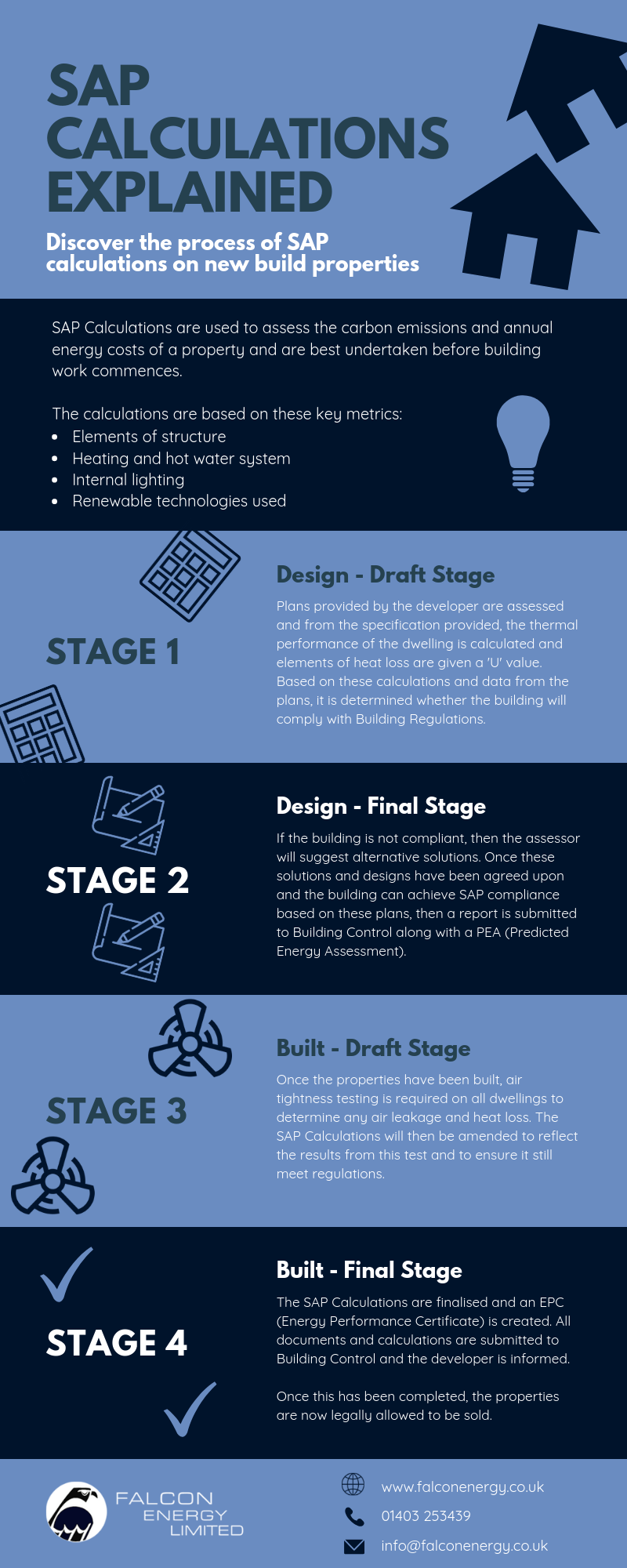
The infographic above outlines the four key stages of SAP calculations. Below, we expand on what each stage achieves, why it is important, and how it influences decisions throughout a new build project.
Stage 1 – Design, Draft Stage: Shaping energy performance early
This stage is less about pass-or-fail and more about direction. It allows developers and designers to understand how early design choices, such as building orientation, glazing ratios, and construction methods, affect energy efficiency before anything is built.
At this point, SAP calculations act as a design optimisation tool, helping to:
- Identify where heat loss is most likely to occur
- Compare construction options before costs are locked in
- Avoid design decisions that could cause compliance issues later
Making adjustments at this stage is significantly more cost-effective than changing specifications once construction begins.
Stage 2 – Design, Final Stage: Locking in compliance with confidence
By the final design stage, SAP calculations shift from exploration to confirmation. All materials, systems, and technologies are finalised, providing certainty for both developers and Building Control.
This is where SAP calculations help to:
- Validate that the agreed specification will meet regulations
- Balance performance improvements against budget constraints
- Confirm the role of renewables in achieving compliance
The resulting documentation provides reassurance that the build can proceed without regulatory risk, reducing the likelihood of delays later in the project.
Stage 3 – Built, Draft Stage: Aligning design with reality
Once construction is complete, SAP calculations move from theoretical performance to real-world validation. This stage bridges the gap between how the home was designed to perform and how it actually performs once built.
It is particularly valuable for:
- Identifying construction-related inefficiencies
- Confirming workmanship aligns with design intent
- Highlighting any improvements needed before final sign-off
This stage ensures that compliance is not just assumed based on plans, but supported by on-site evidence.
Stage 4 – Built, Final Stage: Certification and legal sign-off
The final stage brings everything together. SAP calculations here serve as the foundation for official certification and legal approval.
At this point, the process delivers:
- A verified EPC rating for the completed property
- Full documentation required by Building Control
- Assurance that the home meets current energy standards
This stage is critical not only for regulatory approval but also for marketability, as EPC ratings are increasingly important to buyers and investors. It also helps ensure everything is in place for the building control officer to complete final sign-off without avoidable delays.
Why this staged approach matters for new builds
Breaking SAP calculations into clearly defined stages ensures energy efficiency is considered throughout the build’s lifecycle, not just at the end. This structured approach reduces risk, controls costs, and supports the delivery of compliant, future-proof homes throughout the wider building process.
As specialist providers, we guide developers through each stage, ensuring the SAP process supports design decisions rather than becoming a last-minute compliance hurdle.
Benefits of SAP Calculations for new builds
Beyond compliance, SAP calculations provide long-term value for developers and homeowners:
- Lower energy bills for occupants
- Reduced carbon footprint
- Improved marketability of new homes
- Early identification of design inefficiencies
- Smoother Building Control approval
Well-planned SAP assessments can also reduce the need for last-minute changes that delay completion.
Professional SAP Calculation services for new build compliance
Working with experienced SAP assessors ensures that SAP calculations are accurate, compliant, and aligned with your build programme. At Falcon Energy, we provide specialist SAP calculations for new builds, supporting developers from initial design through to final EPC certification.
Our end-to-end service at Falcon Energy helps streamline compliance, reduce risk, and ensure every property meets current Building Regulations efficiently.
Final thoughts
Understanding what SAP calculations are for new builds is essential for anyone involved in residential property development. From early design decisions to final certification, SAP assessments play a central role in delivering compliant, energy-efficient homes that meet today’s regulatory and environmental standards.
If you’re planning a new build project, integrating SAP calculations early and using them strategically can make the difference between delays and a smooth, successful completion.
Find out more about our SAP calculation services by getting in touch with our team on 01403 253439. We would be happy to help.